
← Back to solvX.uk Get a £20 audit →
solvX · Websites, SEO & GEO

Get found on Google — and in ChatGPT

More customers now ask an AI assistant instead of typing into a search box. We make small-business websites that search engines rank and AI assistants can read, quote and recommend. Below is the whole method, free, step by step. Or we'll do it for you: a £20 audit, or a rebuilt site with auto-deploy, analytics and admin editing from £50, paid once, with free hosting.

Why people can't find you

Most small-business sites are quietly losing customers

Not because the business is bad, but because the website is hard for search engines and AI assistants to read. These are the problems we see most. The first three were all on our first client's site:

Wrong facts

Opening hours, phone numbers or services that don't match your Google listing. Search engines lose trust, and customers turn up when you're shut.

Invisible to AI

No summary for AI assistants, no structured data, and no answers to the questions people actually ask. ChatGPT can't recommend what it can't read.

Slow on a phone

Full-size photographs that take seconds to load on mobile, where most local customers are browsing.

No idea what's working

No record of visits or where they come from, so there's no way to tell if anything you change makes a difference.

Do it yourself — free

How to get your website found on Google and in ChatGPT

This is the method we use on client sites, in ten steps. Most of it is free and takes an afternoon. If you'd rather not, we'll do it for you.

  1. Register with Google and Bing

    Add your site to Google Search Console and Bing Webmaster Tools, then submit your sitemap (usually yoursite/sitemap.xml) to both. Bing matters more than people think: it also feeds Microsoft Copilot and part of ChatGPT's search.

  2. Fix the basics

    Serve the site at one address over HTTPS (redirect www to the plain domain, or the reverse). Give every page a unique title of 50–60 characters that says what you do and where, a description of about 150 characters, and one main heading.

  3. Make your facts match everywhere

    Your business name, address, phone number and opening hours should be written identically on your website and your Google Business Profile. Mismatches cost trust with search engines and with customers.

  4. Let AI assistants in

    Open yoursite/robots.txt and check you aren't blocking the crawlers behind ChatGPT, Perplexity, Claude, Gemini and Copilot (for example OAI-SearchBot, PerplexityBot, ClaudeBot). Keep private pages such as admin and stats blocked.

  5. Add an llms.txt summary

    A short plain-text file at yoursite/llms.txt: one line on what the business is, then a list of your key pages with a sentence each. It gives AI assistants an accurate description to work from.

  6. Add structured data

    Describe the business in schema.org JSON-LD: LocalBusiness with your address, hours and phone, and FAQPage for your questions and answers. Link your Google Business Profile and social accounts with sameAs so everything is recognised as one business.

  7. Answer the questions people ask

    Write an FAQ that answers cost, turnaround and guarantee plainly. These are the questions people want answered before they get in touch, and AI assistants quote clear answers word for word.

  8. Make it fast on a phone

    Resize photographs to the size they're shown at and save them as WebP or well-compressed JPEG. On our first client's gallery page this took the download from 47 MB to under 2 MB, with no visible loss of detail.

  9. Tell search engines when you change

    Use IndexNow to notify Bing and other engines the moment a page changes, instead of waiting to be re-crawled. Submit only the pages that actually changed.

  10. Measure it

    Before you change anything, write down your current visits and where they come from (search, social, direct, AI assistants). Then watch the trend week by week. Results take weeks to months, so the baseline is what proves it worked.

Want the checklist to run itself? Our audit is available free as an open-source skill for Claude Code: point it at your website project and it checks everything above. Get the free SEO skill on GitHub ↗

Or we'll do it for you

Audit, rebuild, or both

80% OFF AI-assisted production keeps our prices around 80% below standard agency rates. UK agencies typically charge £300 or more for an AI-visibility audit alone.

SEO & GEO audit

£20

We check your existing site, whatever it's built on, against the full method above.

  • Search, AI and speed checks
  • Plain-English report
  • Fixes in priority order

Simple site

from £50

A rebuild of a straightforward site, such as a few pages for a local service, made fast and findable.

  • SEO & GEO built in
  • Auto-deploy: changes live in minutes
  • Private analytics dashboard
  • Google & Bing registration
  • Free hosting: pay once

Complex site

£100+

Bigger sites, more pages, or features: everything in Simple, plus what your business needs.

  • Admin editing: update it yourself
  • Enquiry forms
  • Moving content off WordPress & co.
  • FAQ & content planning

Free hosting — we become your backend

Pay once for the rebuild and we take over the hosting for free, with no monthly fee: the site, automatic deploys and your analytics dashboard. You manage your own content through the admin editor. Prefer your own hosting? We'll deploy there instead. Try the editor demo →

Add video to your site

Pair your new site with a promo or explainer video, placed with the structured data search engines need to understand it. See video production →

How it works

A website that keeps itself in shape

This is the workflow that runs solvX.uk, offered to your business: every change goes live through the same checked, automatic path, and every visit is measured.

1

Audit

We find what's stopping search engines and AI assistants from reading your site, and record a baseline.

2

Rebuild

A fast, simple site with your content, accurate facts, structured data and an FAQ.

3

Auto-deploy

Every change goes live through an automatic, checked deploy. Search engines are told about it straight away.

4

Analytics

A private dashboard shows visits, where they came from and what people read. No cookies.

5

You edit

Change your own text, prices and hours in an admin editor, if you want to.

6

We improve

We watch the numbers and keep tuning for search and AI, so the site gets better instead of going stale.

Case study

Logarhythm: a repair workshop, made findable

Client · live site

Logarhythm ↗ — synth & studio electronics repair, Tottenham

A North London workshop that repairs, designs and builds synthesisers and studio electronics. The site had years of steady visitors, but it was on WordPress.com, slow on phones, and telling people the wrong opening hours.
RebuiltMoved off WordPress.com to a static site on UK hosting, with automatic deployment: every change is built, checked and published in minutes.
Facts fixedOpening hours now match the Google listing. The old site advertised Sunday opening; the workshop is closed on Sundays. Phone number written the same way everywhere.
PhotosGallery page photographs cut from 47.3 MB to about 1.9 MB; the largest single photo from 4.1 MB to 168 KB, with circuit-board detail still readable.
SearchRegistered with Google and Bing, sitemap submitted, IndexNow notifications on every deploy, and a broken old address that Google was still showing redirected to the right page.
AI assistantsAI search crawlers allowed in, an llms.txt summary added, and the business, its Google listing and Instagram described as one entity in structured data.
AnswersA new 18-question FAQ, including cost, turnaround and guarantee, in the main menu on every page.
MeasuredTheir own private, cookie-free analytics, with a recorded starting point to measure against.
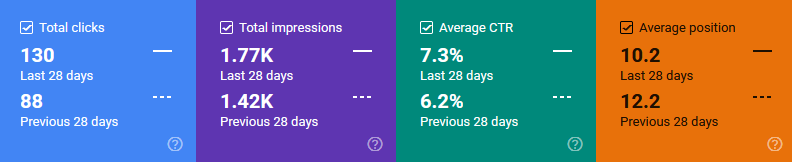
ResultsIn the 28 days after the main changes went live, compared with the 28 days before: Google showed the site 25% more often and sent 48% more clicks. The repairs page appeared 37% more often, and the repaired Evolver story now ranks at its proper address. The site has also started appearing on Bing, where it wasn't registered before. Four weeks on one site isn't proof of cause, but every measure moved the right way.
+48%
clicks from Google
88 → 130
+25%
times shown in Google
1,418 → 1,774
7.3%
click-through rate
up from 6.2%
12 → 10
average position
about two places higher
Google Search Console for logarhythm.co.uk, last 28 days against the previous 28: total clicks 130 vs 88, impressions 1.77K vs 1.42K, average CTR 7.3% vs 6.2%, average position 10.2 vs 12.2
Straight from Google Search Console: last 28 days compared with the previous 28 days (November 2026).

“I didn't want an agency selling me rankings. solvX fixed what was actually wrong, showed me the numbers before and after, and Google is sending us more people.”

— Matt, Logarhythm

Common questions

Websites, SEO and GEO: what people ask

What is GEO?
GEO stands for generative engine optimisation: making your website easy for AI assistants such as ChatGPT, Perplexity, Claude, Gemini and Copilot to read, understand and recommend, with a link back to you.
What's the difference between SEO and GEO?
SEO gets your pages ranked in search results like Google. GEO gets your business described and cited correctly inside AI assistants' answers. They share foundations (a fast, well-structured, accurate site) and GEO adds things like allowing AI crawlers, an llms.txt summary and clear question-and-answer content.
How do I get my business to show up in ChatGPT?
Make sure ChatGPT's search crawler is allowed in your robots.txt, register with Bing Webmaster Tools (ChatGPT search draws partly on Bing), describe your business with structured data, add an llms.txt summary, and publish plain answers to the questions customers ask. Nobody can guarantee a mention, but these steps make you readable and quotable. The free guide above walks through each one.
What's included in the £20 SEO & GEO audit?
We check your existing site against the full checklist: search engine registration, titles and descriptions, headings, speed, structured data, AI crawler access, llms.txt, business facts and FAQ content. You get a plain-English report with the fixes in priority order, which you can do yourself or ask us to do.
How long until I see results?
Technical fixes usually take effect within weeks, once search engines re-read the site. Content and reputation build over months. We measure from a recorded starting point so you can see the trend, and we don't predict rankings. For our first client, Logarhythm, clicks from Google were up 48% in the four weeks after the main changes went live, though one site isn't a promise.
Do you guarantee first page on Google?
No. Nobody controls Google's rankings, and anyone who guarantees a position is guessing. We make your site correct, fast, readable by search engines and AI assistants, and measured, then show you the trend.
Can I update my own website after you build it?
Yes, if you want to. We can add an admin editor so you change your own text, prices and opening hours, while we run the technical side as your backend. Try the editor demo.
What does a website rebuild include?
A fast rebuilt site with SEO and GEO built in, automatic deployment so changes go live safely in minutes, first-party analytics with a private dashboard, registration with Google and Bing, automatic change notifications to search engines, and free hosting. Larger sites can add an admin editor, forms and migration of existing content.
Do I have to pay for hosting?
No. Hosting is currently included free with a rebuild: you pay once for the site and we host it at no monthly cost. If you'd rather keep your own hosting, we can deploy the site there instead.
My site is on WordPress, Wix or Squarespace. Can you help?
We can audit any public website. If a rebuild makes more sense, we move your content to a fast, simple site that deploys automatically. Our first client, Logarhythm, moved off WordPress.com this way.
Do your analytics need a cookie banner?
Our analytics don't set cookies. They record visits, where visitors came from and which pages they read, into a private dashboard on your own site, without third-party trackers.
What is llms.txt?
A short plain-text file at the root of your website that summarises your business and links your key pages, written for AI assistants to read. It helps them describe you accurately.
Should I put my prices on my website?
Usually, yes. Cost is the question people most want answered before they get in touch, and AI assistants can only quote prices that are published. A starting price or a clear range is enough.
Can you add video to my website?
Yes. We also make promo and explainer videos from £20, and can place them on the rebuilt site with the right structured data so search engines understand them. See video production.
What do you need from me to start?
For an audit, just your web address. For a rebuild, access to your domain settings and, if you have them, your Google Search Console and Google Business Profile. We walk you through anything you're unsure of.

Want to be found?

Send us your web address. We'll start with the £20 audit, or tell you honestly if a rebuild makes more sense.

Or book a 15-min call

Prefer email? solutions@solvx.uk

solvX is a UK-based creative-technology and AI-engineering studio, working remotely with clients anywhere. We also make video, 3D animation and playable prototypes.